Short answer
Replacing a central AC in New Orleans usually means a new outdoor unit and a matched indoor coil, and sometimes a new air handler, sized from a load calculation rather than the old unit's label. The installer recovers the old refrigerant, flushes or replaces the line set, pulls a deep vacuum and charges by weight. Most homes keep their ductwork if it is sound.
When replacement makes sense

Repair usually wins until the system is old and the repair is big. A common rule of thumb multiplies the system's age by the repair price; past about $5,000, replacement usually makes more sense. Units still running on R-22, rusted cabinets and failing compressors on older systems push the same way.
The install matters as much as the brand. A matched coil, the right line set, a proper vacuum and a charge by weight decide efficiency and life span. We install Carrier, Trane, Lennox, Goodman, Rheem and Daikin, and check the ducts so the new unit gets the airflow it needs. Heat pumps are covered under heat pump installation.
Single-stage, two-stage or variable-speed
| Single-stage | Two-stage | Variable-speed | |
|---|---|---|---|
| Up-front cost | Lowest | Middle | Highest |
| Humidity control | Fair | Better | Best |
| Noise | Loudest | Quieter | Quietest |
| Best for | Tight budgets, well-sized houses | Most homes | Humid houses and long run times |
What an AC replacement costs
- Size. Tonnage comes from the load calculation.
- Efficiency and staging. Two-stage and variable-speed units cost more.
- Coil or air handler. A worn air handler adds to the cost of a coil.
- Line set. Replacing the copper costs more than flushing it.
- Electrical and stand. A new disconnect, breaker or raised stand adds parts.
Planning range: about $3,000 to $7,500 for a central AC replacement, unit and installation; a new air handler or ductwork adds to it (source: searshomeservices.com). It is a market range, not our price; we quote after we see the system.
What an AC replacement includes
- Load calculation for the house as it is now
- Matched outdoor unit and indoor coil
- Old refrigerant recovered and equipment hauled away
- Line set replaced or flushed and pressure tested
- Deep vacuum and charge by weight
- Anchored pad or raised stand
- Start-up readings and thermostat setup
A matched condenser and coil
The outdoor unit and indoor coil are designed as a pair, and the efficiency rating only holds when they are matched. A new condenser on an old coil can leave the system less efficient than its label, short on capacity, and prone to failure when the old coil leaks. We replace the coil, or the whole air handler when it is worn, with the match the manufacturer lists, set the correct metering device, and confirm the pairing with start-up readings so the system performs the way it was rated.
Replacing an R-22 system
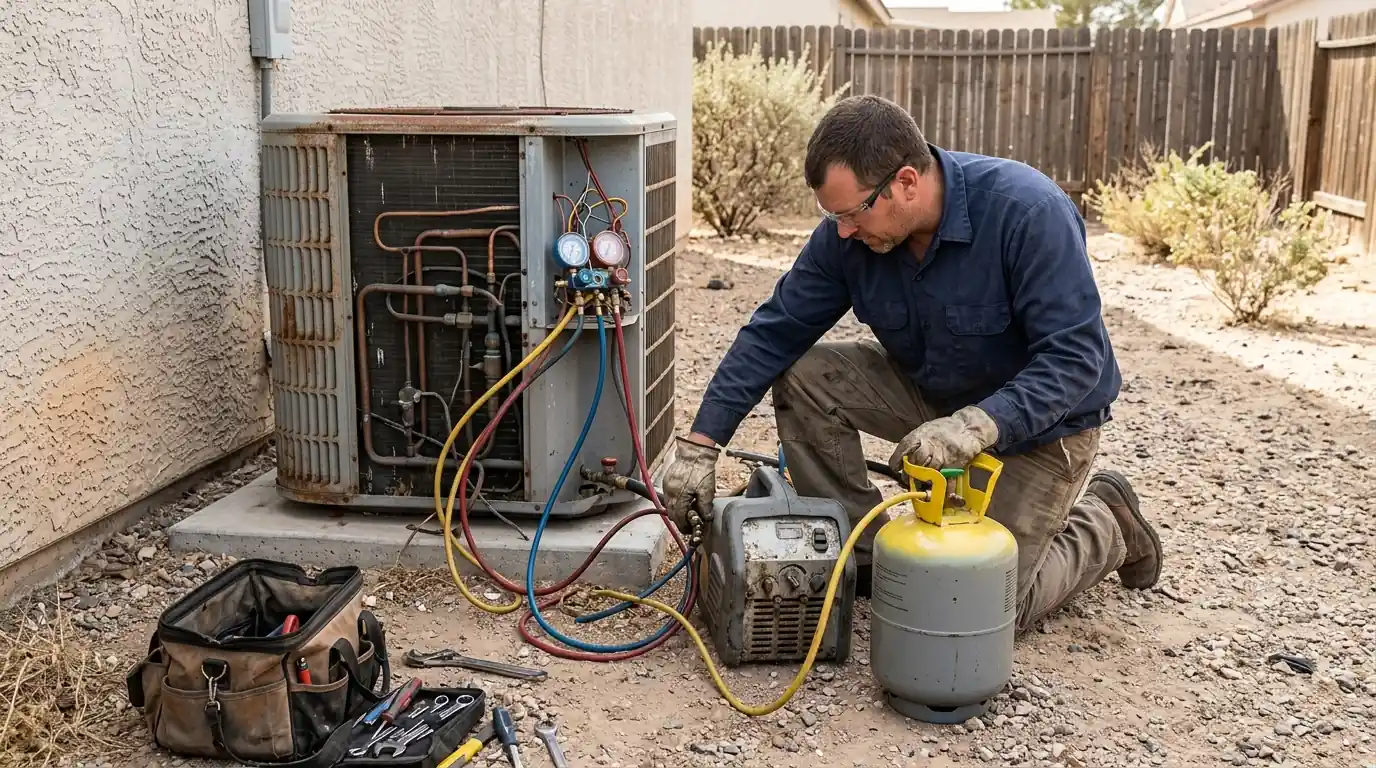
R-22 has not been used in new equipment for years, and the refrigerant still available is expensive. If an R-22 system develops a leak or needs a compressor, replacing it usually makes more sense than recharging it. A changeout means the old refrigerant is recovered, the indoor coil is replaced along with the outdoor unit, and the line set is either replaced or cleaned and tested so leftover oil does not contaminate the new system. We check the line set's size and route before quoting, since that affects the price.
Sizing a replacement with a load calculation
The old unit's size is a starting point, not an answer. Houses change: new windows, attic insulation, a closed-in porch, a renovated kitchen. A load calculation looks at the house as it is now and tells us how much cooling each room needs, which often lands on a different size than the old label. In our humid climate a right-sized variable-speed unit usually handles humidity better than a big single-stage one that cools fast and shuts off before the air dries.
Efficiency floors and rebates
Any new central AC installed in Louisiana must meet at least 14.3 SEER2, so that is the floor for even the most basic replacement. In New Orleans, Entergy's Energy Smart program has offered up to $500 back on a qualifying ENERGY STAR central air unit, and some upgrades must be done by a participating trade ally. We lay out the efficiency options side by side so you can weigh the rebate and the monthly bill against the price.
How a replacement runs
- Load calculationThe house as it is now, room by room.
- Options and quoteEfficiency levels side by side, with the price.
- Remove the old systemRefrigerant recovered, equipment hauled away.
- InstallMatched equipment, line set, vacuum and charge by weight.
- Start upReadings checked and the thermostat set up.