Short answer
If the outdoor unit runs but no air comes from the vents, the indoor blower has stopped. The usual causes are a failed capacitor on older PSC motors, a failed control module on variable-speed ECM motors, or worn bearings. A technician confirms the motor is being told to run, tests the capacitor or module, and repairs or replaces the motor to match the air handler.
Signs the blower is failing
How blower motors fail
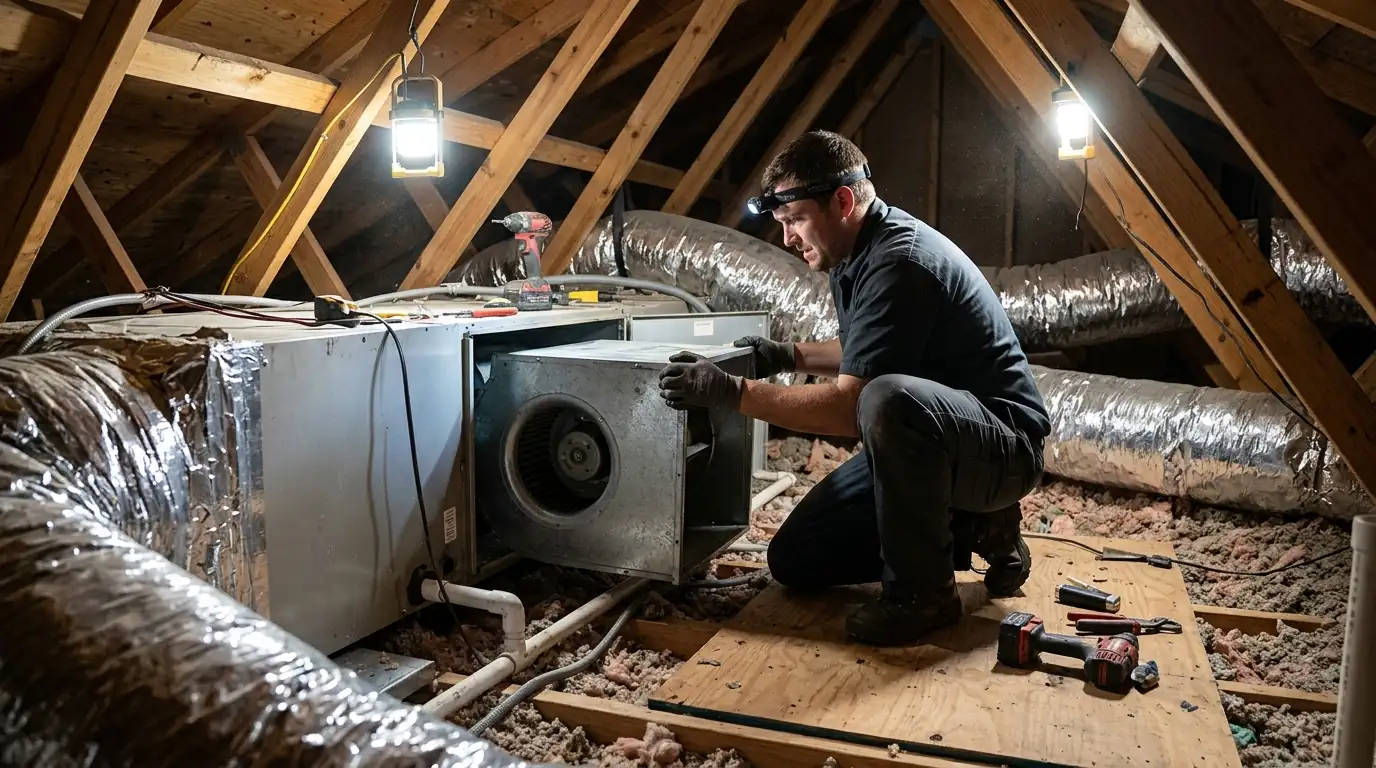
Older air handlers use a PSC motor with a separate capacitor, and a failed capacitor is the cheapest fix in the cabinet. Newer systems use variable-speed ECM motors, which run quieter and more efficiently, but their electronic module can fail on its own, especially after a power surge.
Blowers in attic air handlers work in brutal heat and catch dust that slips past a weak filter. A caked wheel moves less air, strains the motor, and can trip the heat strip limits and freeze the coil. We work on blowers in Trane, Carrier, Goodman, Rheem and Lennox air handlers.
No air from the vents
When the thermostat calls and the outdoor unit starts but the vents stay still, we start at the air handler. We check that the control board is sending a call to the blower, test the capacitor on PSC motors, feel for seized bearings and measure the motor's windings. A failed capacitor is replaced on the spot; a seized or open motor is replaced with one matched for horsepower, speed taps and rotation. Then we check the coil for ice, because a stopped blower often leaves some behind.
Variable-speed (ECM) motor module failures
Variable-speed motors carry an electronic module bolted to the back of the motor. When it fails, the blower may not start, may run at one speed only, or may surge. On many motors the module can be replaced on its own, which costs less than a whole motor, provided the motor half tests good. We test the motor and module separately, confirm the right programming for that air handler, and look for the surge or moisture damage that killed the first module before installing a new one.
Cleaning a caked blower wheel
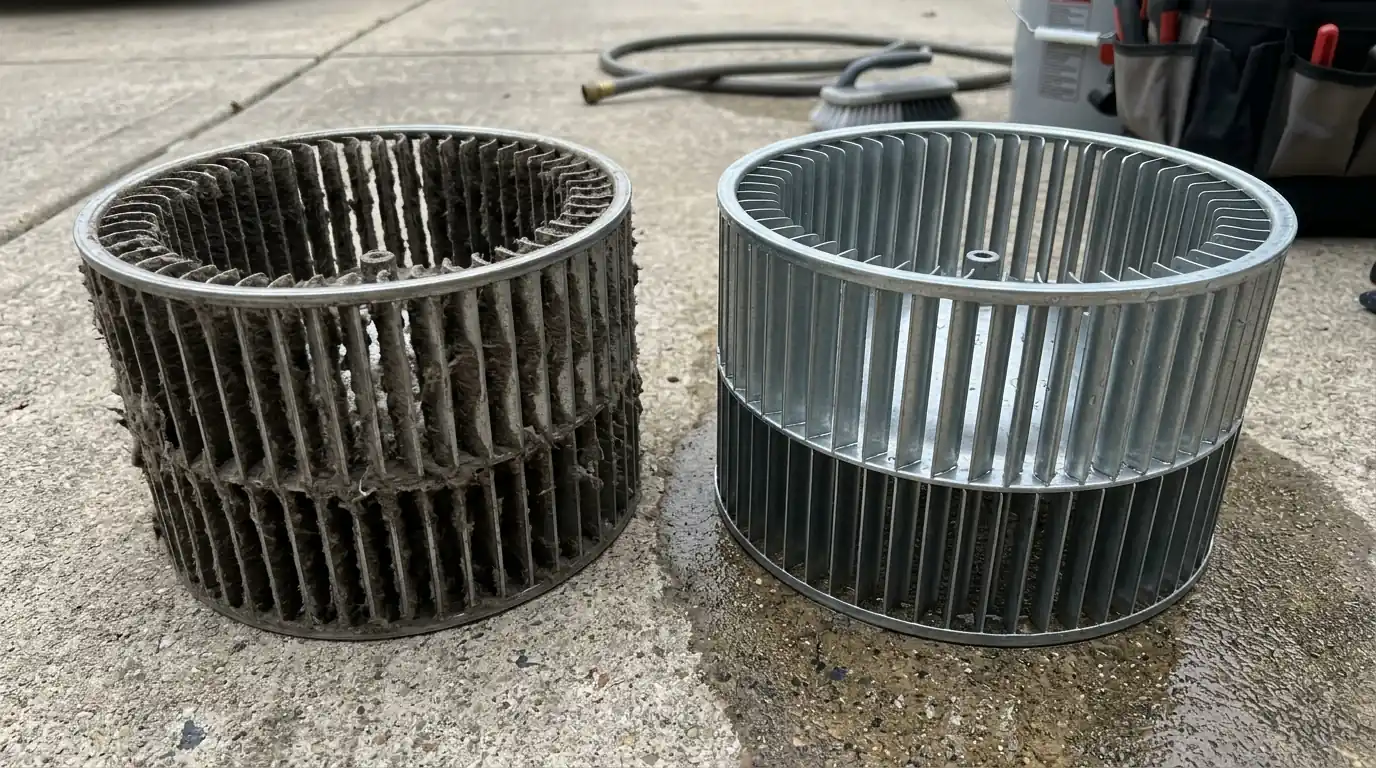
A blower wheel's curved blades collect dust and grease until the wheel looks felted. A caked wheel moves far less air even with a healthy motor, which leaves rooms warm, freezes coils and raises bills. Cleaning it properly means shutting off power, removing the whole blower assembly from the cabinet, washing the wheel, checking its balance and the motor's bearings, and reinstalling it on the correct speed tap. It is often paired with coil and blower cleaning, since the same dust usually coats both.
Attic air handlers in Metairie and Kenner
The largest share of Metairie homes was built in the 1970s, with the 1960s close behind, and most Kenner homes went up in the 1970s and 1980s. Houses from those decades usually keep the air handler in the attic, where summer heat pushes blower motors and their electronics hard, and where a failing motor is easy to miss until the vents go quiet. That is why we check blower amp draw on every tune-up in those homes.
How we repair a blower
- Confirm the callBoard and thermostat signals checked first.
- Test the partsCapacitor, windings, module and bearings measured.
- Repair or replaceMatched motor, module or capacitor installed.
- Clean what is cakedWheel and housing cleaned when dirty.
- Check the coil and airflowIce cleared, airflow and amp draw confirmed.
What decides the cost of a blower repair
We have no sourced local range for blower work, so these are the factors that move it.
- Capacitor or motor. A capacitor costs far less than a motor.
- PSC or ECM. Variable-speed motors cost more than standard ones.
- Module only. Replacing just an ECM module costs less than a full motor.
- Wheel cleaning. A caked wheel adds time to pull and wash.
- Access. Tight attics and closet units take longer to work in.
Replacing with a standard or variable-speed motor
| Standard PSC motor | Variable-speed ECM motor | |
|---|---|---|
| Up-front cost | Lower | Higher |
| Running cost | Higher | Lower |
| Humidity control | Fixed speeds | Can slow down to pull more moisture |
| Makes sense when | The air handler is near replacement | The air handler has years left |