Short answer
A refrigerant leak in New Orleans usually shows as warm air, ice on the copper line, a hissing sound or a system that needs a recharge every summer. Leak repair means finding the leak with electronic detectors, bubble solution or a nitrogen pressure test, repairing it by brazing or replacing the leaking part, then pulling a vacuum and charging by weight. Coils are the most common leak point.
Signs of a refrigerant leak
How leaks are found and fixed
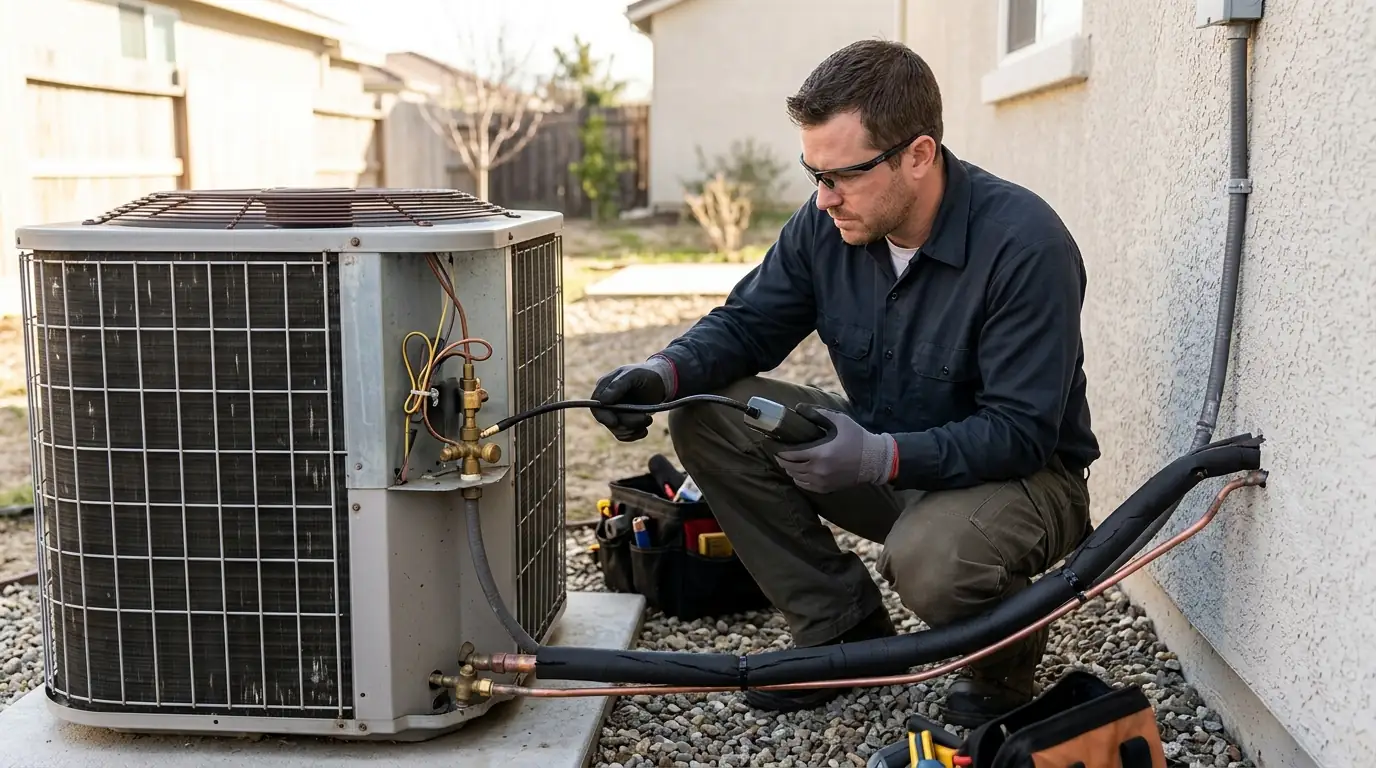
Leaks are usually small and slow: a pinhole in an evaporator coil, a cracked flare fitting, a rubbed line set, a leaking service valve. We check the likely points with an electronic detector and bubble solution, and when the leak hides, we recover the refrigerant and pressure-test with nitrogen to isolate it section by section.
Once found, the fix depends on where it is. Fittings and short line sections can be repaired; a leaking coil is usually replaced, since patches on thin coil tubing rarely last. On an older system we compare the repair against an AC replacement before you spend the money.
Leaks in older R-22 systems
R-22 has not been used in new equipment for years, and what is still available is costly. A leak on an R-22 system therefore raises a bigger question than the repair itself. If the leak is small and in a fitting, a repair and recharge can make sense for a system that is otherwise healthy. If the coil is leaking or the system is old, replacement usually wins. We find the leak first, then price both options so the decision rests on real numbers rather than a guess.
Recharging after the leak is fixed
After a repair, the system is evacuated with a vacuum pump to remove air and moisture, and we watch the vacuum hold to confirm the repair is tight. Then we charge by weight to the amount on the unit's data plate, adjusted for the line set length, and confirm with superheat or subcooling readings once it runs. Topping off a system by feel, without a vacuum, leaves air and moisture inside, which forms acid in the oil over time and almost guarantees another service call.
Leaking evaporator coils
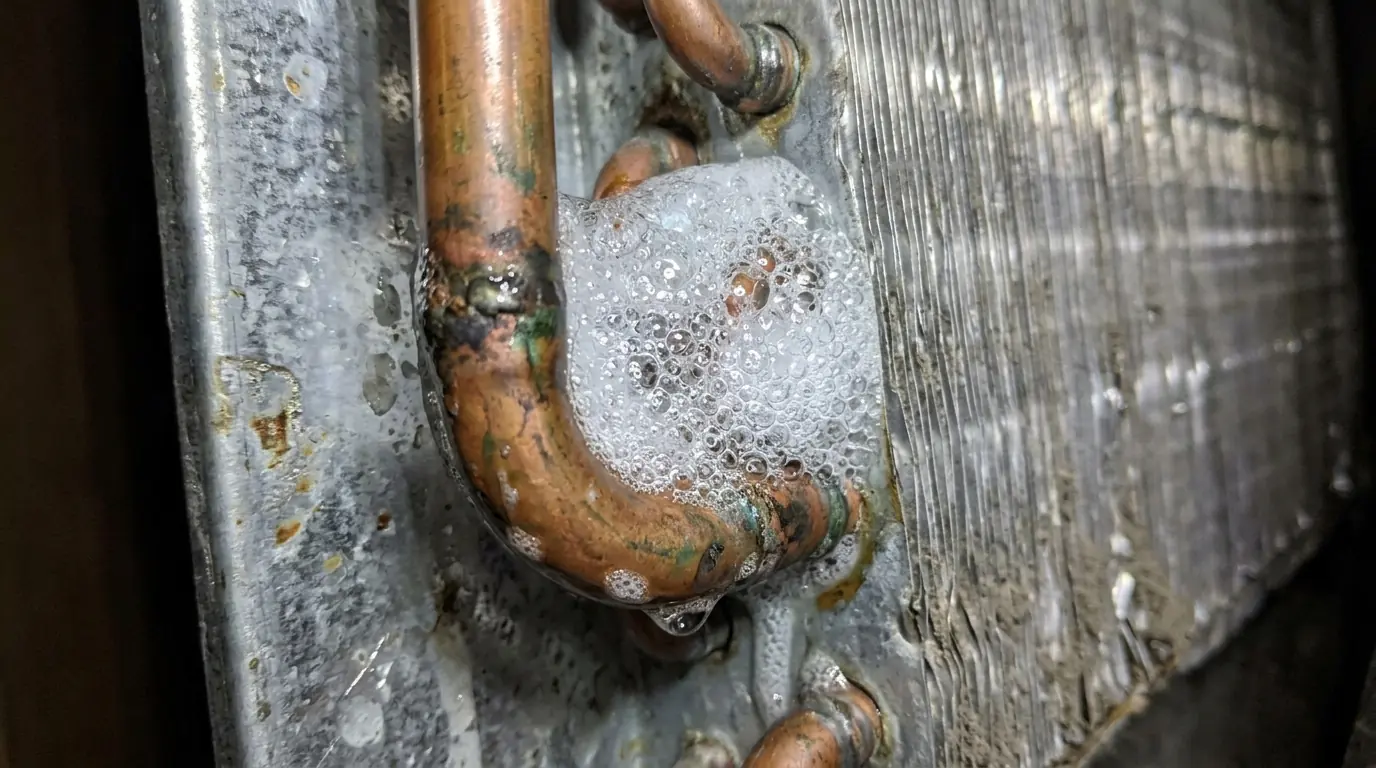
The indoor coil is the most common leak point in many systems, especially older ones with thin copper tubing. Formicary corrosion, a pitting caused by chemicals in indoor air, leaves pinholes that leak slowly. These are hard to repair reliably, so a leaking coil is usually replaced. We confirm the leak is in the coil, then quote a matched evaporator coil replacement. A coil still under the maker's parts warranty may cost only labor and refrigerant, and on older systems we price a full replacement alongside it.
Line set leaks under raised houses
Refrigerant lines running under a raised house are exposed to damp air, animals and contact with framing, and copper rubbing against a joist or pipe can wear through over the years. We trace the line set along its full length, check for rub points, damaged insulation and loose supports, and repair or replace the damaged section. Where the old line set is long, rubbed in several places or sized wrong for new equipment, replacing the whole run is often the better fix.
R-22 systems in Metairie and Kenner
Most Metairie homes were built in the 1960s and 1970s, and most Kenner homes in the 1970s and 1980s. In houses that age, the AC out back may be one of the last R-22 systems on the street, and a leak forces a choice between an expensive recharge and a replacement. We find the leak first, so that choice is made on facts rather than on how much refrigerant the system happens to need this summer.
How we find and fix a leak
- Confirm the low chargePressures and temperatures, not a guess.
- Find the leakDetector, bubbles, then nitrogen if it hides.
- RepairBraze, replace a fitting, or replace the part.
- Vacuum testThe system must hold a deep vacuum.
- Charge by weightThen confirmed with superheat or subcooling.
What a leak repair usually costs
- Leak location. A fitting costs far less than a coil.
- Refrigerant type. R-22 costs much more than newer refrigerants.
- Amount of refrigerant. Long line sets and large systems hold more.
- Part replacement. Coils and line sets add parts and labor.
- Access. Attic coils and under-house lines take longer to reach.
Planning range: about $200 to $1,500 or more for a refrigerant leak repair; a coil replacement costs more (source: thisoldhouse.com). It is a market range, not our price; we quote after we see the system.
Repair the leak, replace the part, or replace the system
| Repair the leak | Replace the leaking part | Replace the system | |
|---|---|---|---|
| When it fits | A fitting or short line section | A leaking coil or long line set | An old or R-22 system with a major leak |
| Cost | Lowest | Middle | Highest |
| How long it lasts | Depends on the rest of the system | As long as the system lasts | Resets the clock |
| Refrigerant | Recharge by weight | Recharge by weight | New system charge |