Short answer
If the outdoor unit hums but its top fan does not turn, the cause is usually a failed fan capacitor or a seized motor. A technician tests the capacitor first, since it is the cheaper part, then checks the motor's windings and bearings. A motor that runs hot and cuts out on its thermal overload is near the end and should be replaced before it takes the compressor with it.
Signs the condenser fan is failing
Why the outdoor fan matters so much
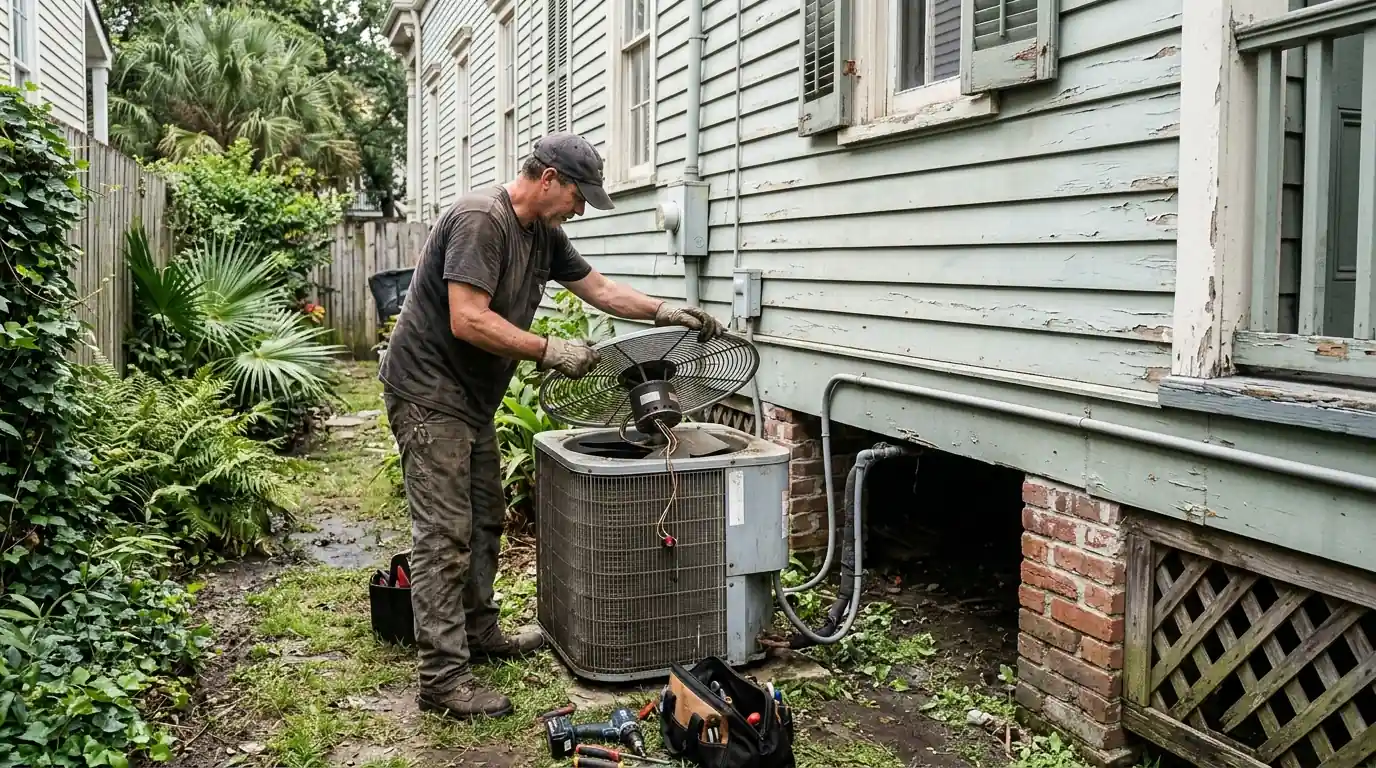
The condenser coil is where your house's heat leaves. Without air moving across it, refrigerant pressure rises within minutes, cooling stops and safety controls start to trip. Run that way long enough and the compressor, the most expensive part in the unit, overheats.
Fan motors here work hard: they spin whenever the compressor runs, through long humid summers, often with grass and leaves in the grille. Most failures start with worn bearings or a weak run capacitor, and a capacitor replacement is often all a slow fan needs.
Fan blade wobble, rattle and bent blades
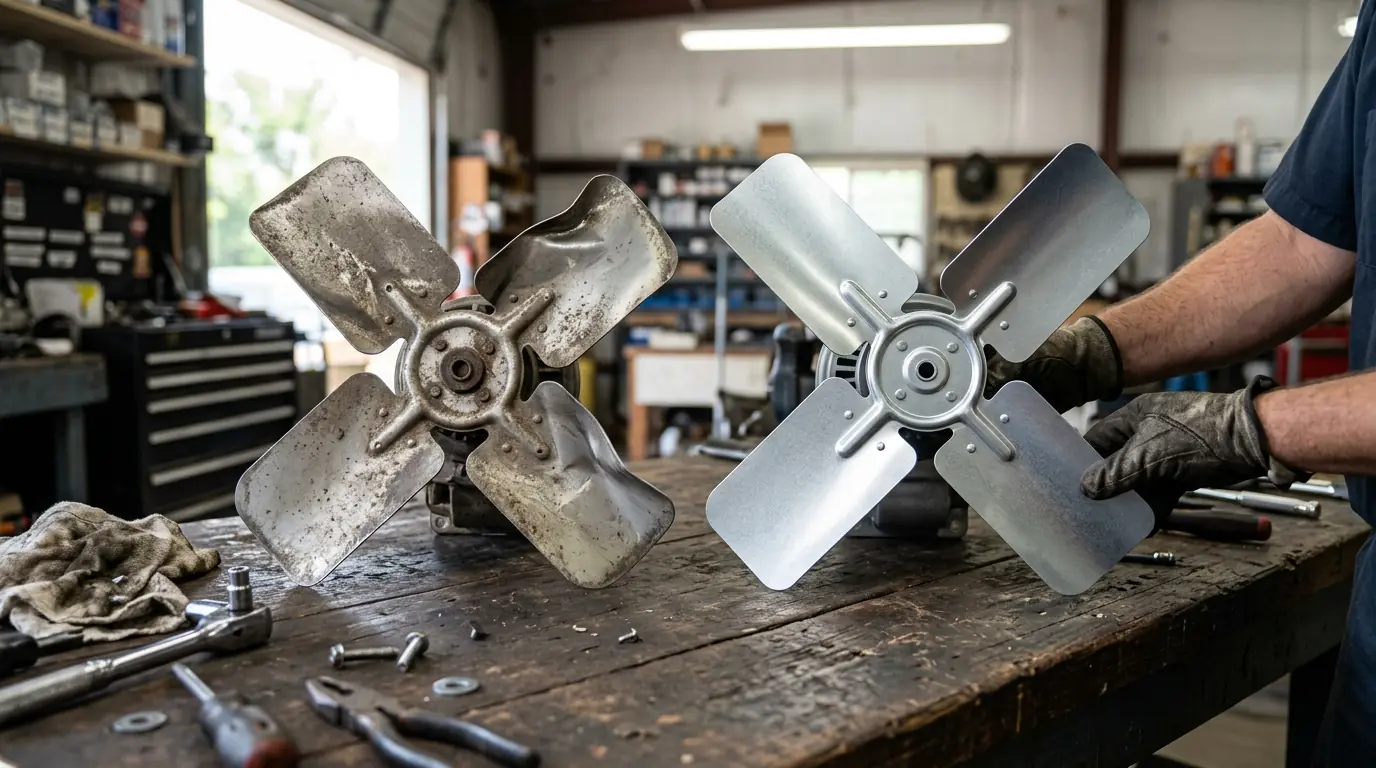
A blade that wobbles or rattles has usually been bent by debris, loosened on its shaft, or worn its motor's bearings unevenly. An unbalanced blade shakes the motor and the top grille, which wears the bearings faster and can crack the mount. We check the blade for bends and cracks, confirm the hub is tight on the shaft, and spin the motor by hand to feel for bearing play. A bent blade is replaced, never straightened, and a motor with loose bearings is replaced at the same time.
Fan motors that overheat and shut off
Many fan motors carry an internal thermal overload that switches the motor off when it overheats and back on once it cools. You notice it as a fan that runs for a while on a hot afternoon, stops, then starts again later. That pattern points to failing bearings, a weak capacitor or a motor drawing too much current. We measure the amp draw against the nameplate, test the capacitor, and replace the motor with one matched for horsepower, speed, rotation and shaft size.
How long you are without cooling
Most fan motors are replaced with a matched or universal motor that fits the existing mount, so the work itself is short once the right motor is in hand. When there is a wait, it is for an exact-match motor on an older or less common unit, and we tell you that on the first visit.
Hot afternoons and outdoor fans
New Orleans averages a July high near 91 degrees, and from mid-July to mid-August the heat index can reach 110 to 115. Those are the afternoons when a condenser fan runs nonstop for hours, and when a motor with tired bearings or a weak capacitor is most likely to overheat and quit. It is also why we measure fan amp draw and test the capacitor at every spring tune-up, before the long heat sets in.
How we replace a condenser fan motor
- Power downWe shut off the disconnect and confirm the unit is dead.
- Test the capacitorThe cheaper part is tested first.
- Check motor and bladeWindings, bearings and blade balance are checked.
- Replace and matchNew motor matched for size, speed, rotation and shaft.
- Run and measureWe measure amp draw and confirm pressures settle.
What changes the cost of a fan motor repair
We have no sourced local range for this repair, so here is what moves the price.
- Capacitor or motor. A capacitor costs far less than a new motor.
- Exact-match or universal motor. Some units take a universal motor; others need the maker's part.
- Blade replacement. A bent or corroded blade is replaced with the motor.
- Access. Rooftop units and tight side yards take longer.
- Collateral damage. A compressor overheated by a dead fan needs its own check.