Short answer
When an outdoor AC unit hums but will not start, or the fan stays still while the compressor tries, a failed run capacitor is the most common cause. A contactor with pitted or burnt points makes the unit chatter, stay off, or stay on when it should stop. A technician measures the capacitor against its rated microfarads and inspects the contactor, then replaces the failed part to the unit's specification.
Signs of a failing capacitor or contactor
What these small parts do
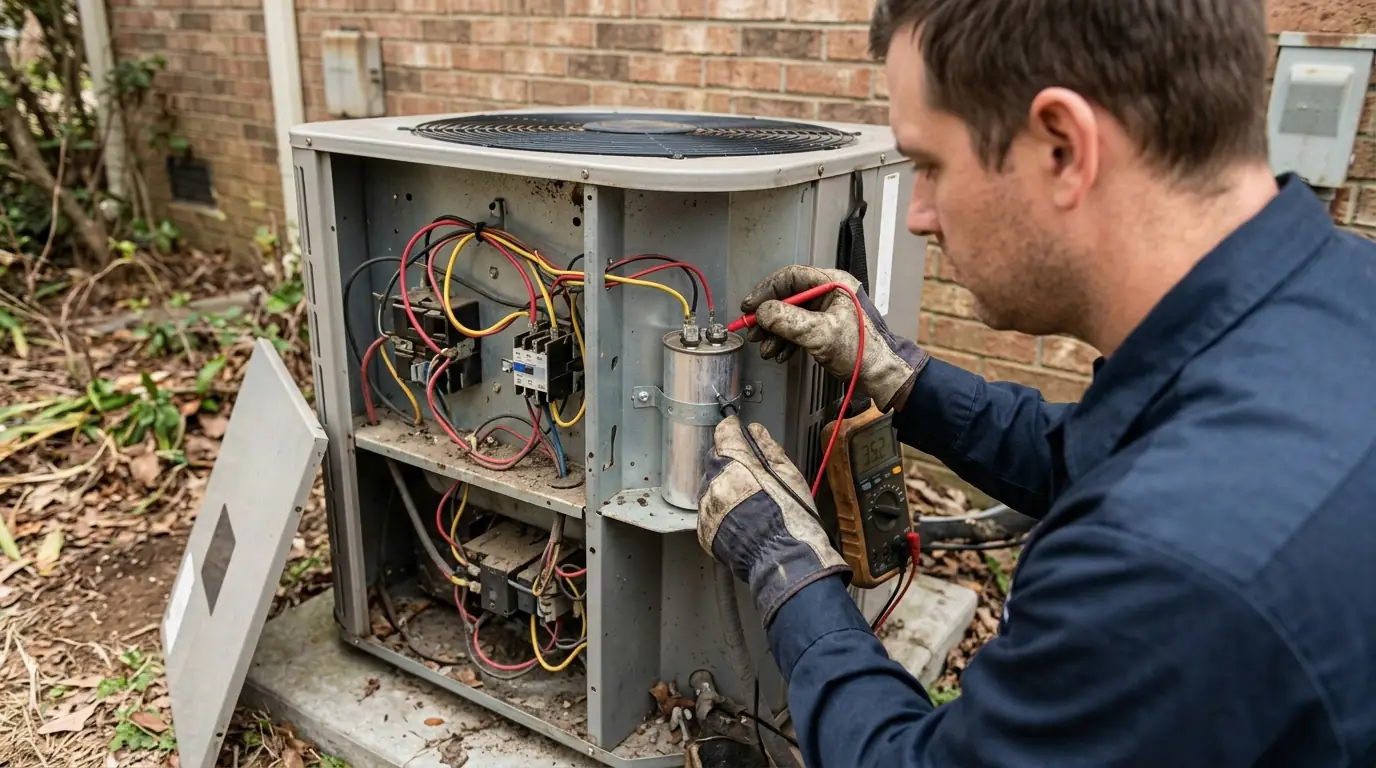
The run capacitor stores and releases energy to start the compressor and outdoor fan and keep them running efficiently. Heat is hard on capacitors, and a unit baking in a side yard all summer wears through them. As one weakens, motors start slowly, run hot and finally will not start.
The contactor is a relay the thermostat closes to power the outdoor unit. Every start draws an arc across its points, and over the years they pit and burn. Ants are drawn to contactors as well, and a nest between the points can stop a unit cold.
Outdoor unit humming but not starting
A steady hum from the outdoor unit with the fan still and no cooling usually means a motor is getting power without enough starting torque. The usual cause is a dual run capacitor that has lost capacity or bulged at the top. Leaving the unit humming risks overheating the compressor windings, so switch it off at the thermostat. We discharge and test the capacitor with a meter, replace it with one matching the rated microfarads and voltage, and check the compressor's amp draw on restart.
Fan not spinning when the unit starts
If the compressor starts but the outdoor fan sits still, or starts only after a nudge, the fan side of the capacitor is often the weak half. A slow fan lets pressures climb and the compressor overheat. We test both sides of the dual capacitor, replace it if either side is out of range, and check the fan motor's bearings. On older units we also look at the wiring at the capacitor terminals for heat damage. If the motor itself is failing, see condenser fan motor replacement.
Pitted, burnt or stuck contactors
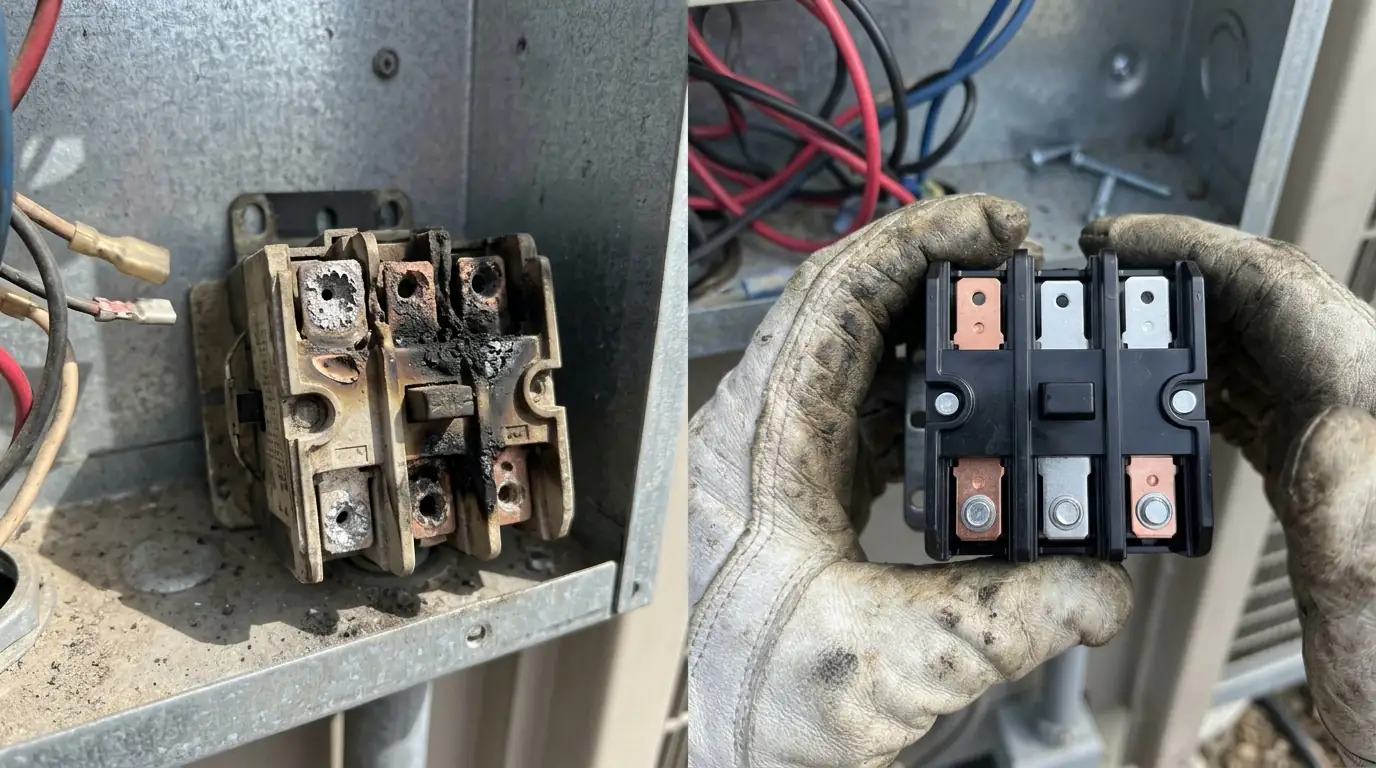
Contactor points pit and burn a little with each start. Worn points cause chattering, a unit that will not start when the thermostat calls, or the opposite: a unit that keeps running after the thermostat is satisfied, which can freeze the coil. Ants and other insects also nest between the points. We inspect the points and coil, clear any debris, and replace a worn contactor with one rated for the unit's voltage and amps. Where repeated failures point to a deeper cause, such as low voltage or a short-cycling thermostat, we chase that down too.
Power outages and restart failures
Hurricane Ida came ashore on August 29, 2021 and left all of New Orleans without power, while more than 100,000 Cleco customers around Slidell and Covington lost power too. Long outages and repeated restarts are hard on capacitors and contactors, and weak parts often fail the first time power comes back. After any long outage we test both before calling a system healthy, because a unit that hums at restart can overheat its compressor quickly.
How we test and replace them
- Power off and dischargeDisconnect off, capacitor safely discharged.
- Measure the capacitorEach side checked against its rated microfarads.
- Inspect the contactorPoints, coil and any insect debris.
- Replace to specNew parts matched for rating, voltage and amps.
- Restart and measureAmp draw and start-up checked with the unit running.
What a capacitor or contactor repair costs
- Which part failed. A capacitor, a contactor or both.
- Dual or separate capacitors. Some units use two single capacitors instead of one dual.
- Hard-start kit. An added start capacitor for an older compressor costs extra.
- Heat-damaged wiring. Burnt terminals or wire add parts and time.
- Compressor condition. A compressor damaged by long humming needs its own check.
Planning range: about $150 to $400 for a capacitor replacement (source: thisoldhouse.com). It is a market range, not our price; we quote after we see the system.
What you can check before we arrive
Safe to check yourself
- Set the thermostat to cool, below room temperature
- Check the breaker and the outdoor disconnect
- Look, without touching, for a bulged capacitor or ants
Leave to a technician
- Touching a capacitor; it can hold a dangerous charge with power off
- Replacing a contactor or any wiring in the unit
- Testing compressor amp draw after the repair