Short answer
If your outdoor unit sat in floodwater, an air handler got wet, or the system will not start after a long outage, do not switch it on. A technician checks the electrical box, control board, contactor, capacitor and compressor terminals for water and surge damage, inspects the coil and line set for impact damage, then repairs or replaces parts before any restart. Flooded equipment often needs replacement.
Signs of storm damage to your system
What storms do to HVAC equipment
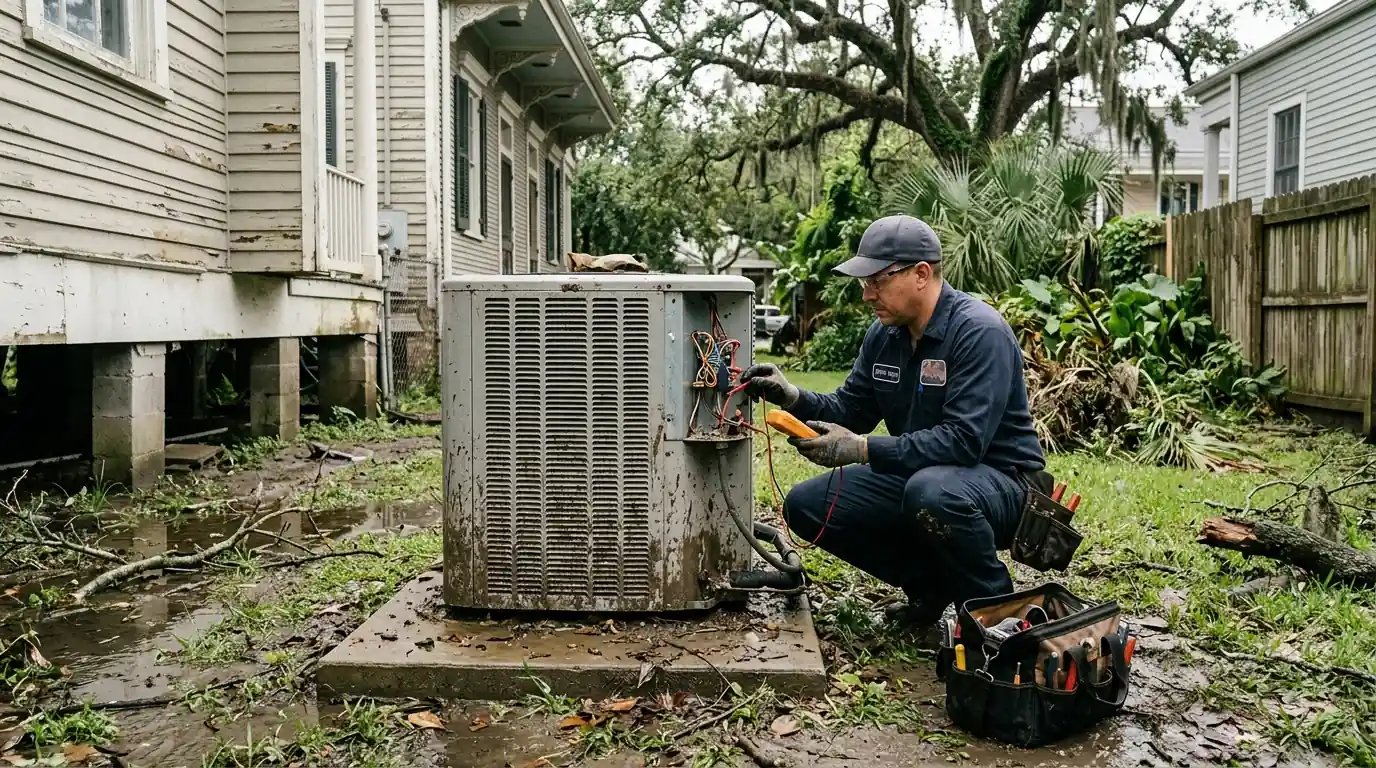
Floodwater ruins electrical parts and leaves silt and salt in coils and motors. Wind throws debris into condenser fins, tips units off their pads and cracks copper lines. Long outages end with surges and sags that kill capacitors, contactors and control boards the moment power returns.
Each needs a different check, so we start with an inspection rather than a restart. Some damage is one part; some is the whole unit. If you are filing an insurance claim, we document what we find with photos and a written assessment. To protect against the next storm, see condenser stands and hurricane straps.
Outdoor units that sat in floodwater
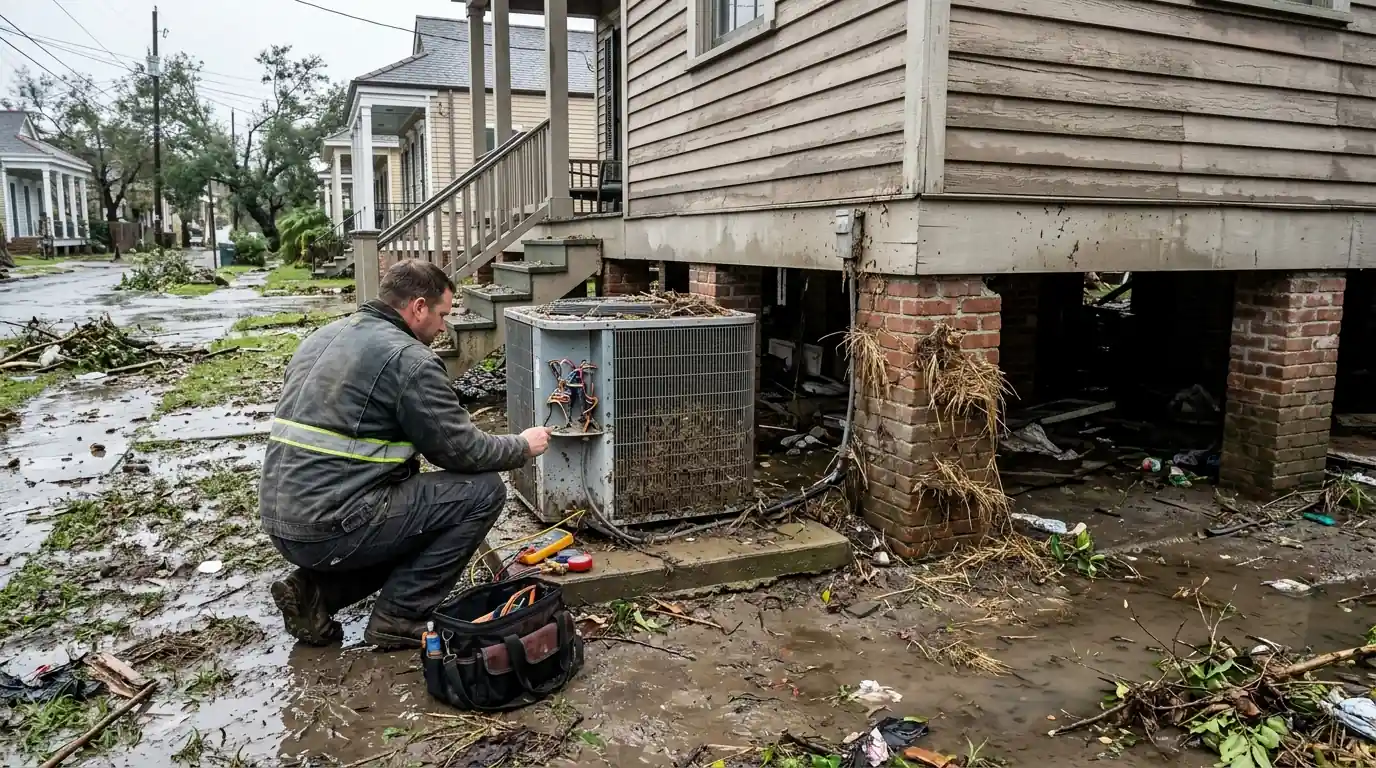
Water that reaches the electrical box or the compressor terminals of an outdoor unit is the start of serious damage, and salt or silt in the water makes it worse. A flooded unit should not be restarted until it has been inspected. We check how high the water rose against the unit's parts, open the electrical box, test the contactor, capacitor, wiring and compressor windings, and look for silt in the coil and fan motor. Units submerged above the electrical parts are often a replacement, and we will tell you plainly.
Wind and debris damage to condensers
High winds bend fins, puncture coils with flying debris, crack fan blades and can tip a unit off its pad, kinking or cracking the copper lines on the way. A cracked line releases the refrigerant charge, and running the system without it damages the compressor. We inspect the cabinet, fan and coil, check for leaks at the lines and fittings, reset and anchor the unit if it moved, and comb the fins where the coil is otherwise sound. Punctured coils and cracked lines are repaired or replaced.
Surge damage when the power comes back
When the grid comes back after a long outage, power often surges or sags as circuits reconnect, and that is hard on the electronics in an HVAC system. Control boards, capacitors, contactors, variable-speed blower modules and thermostats are the usual casualties. We test each in turn rather than replacing parts on a guess, check the incoming voltage, and watch the compressor start. Turning the system off at the thermostat before power returns, then on again once it is steady, can save many of these parts.
What Ida taught New Orleans about restarts
Hurricane Ida came ashore on August 29, 2021 with 150 mph winds and left all of New Orleans without power for days, while floodwater surrounded homes near Norco in St. Charles Parish. Both kinds of damage came back as HVAC calls: units that sat in water and could not be saved, and units that failed the moment the power returned. The lesson holds for every storm since: inspect first, restart second.
How a storm-damage visit runs
- Keep it offNo restart until the inspection is done.
- Inspect and documentPhotos and notes for your records or adjuster.
- Test the electrical sideBox, board, contactor, capacitor, compressor.
- Check coil and refrigerantImpact damage, leaks and line condition.
- Repair or replace, then restartOnly when it is safe to run.
What decides the cost of storm repairs
Storm repairs range from one part to a full system, so there is no honest single figure. Storm damage may fall under a homeowner's insurance claim, depending on the policy.
- Flood height. Water above the electrical parts usually means replacement.
- Coil and line damage. Punctures and cracked lines need brazing or new parts.
- Surge-damaged electronics. Boards, modules and thermostats vary in price.
- Refrigerant loss. A leak is fixed before the system is recharged.
- Repair or replace. Older flooded units are often not worth saving.
What to do right after the storm
What to do right away
- Leave the system off at the thermostat and the breaker
- Photograph the units and any water lines for insurance
- Clear loose debris around the outdoor unit once it is safe
Leave to a technician
- Restarting a unit that sat in water
- Opening electrical panels or testing parts
- Straightening a tipped unit with lines still attached