Short answer
Replacing an air handler in New Orleans means removing the old unit, setting a new one matched to the outdoor unit, connecting the supply and return plenums, refrigerant lines, wiring and heat strips, and installing a new secondary drain pan and float switch. It makes sense when the cabinet is rusted, the coil leaks, or the blower and controls are failing on an older unit.
When an air handler needs replacing
Air handlers in hot attics and damp closets age hard. Cabinets rust from the bottom up, drain pans corrode, coils leak, and blower motors and control boards wear out. When several of these show up together on an older unit, a replacement usually costs less over time than replacing parts one by one.
Matching matters. The air handler's coil and blower have to suit the outdoor unit, or efficiency and capacity fall short. If the outdoor unit is also old, we price a full AC replacement alongside it. We install air handlers from Carrier, Trane, Lennox, Goodman and Rheem.
Standard or variable-speed air handler
| Standard blower | Variable-speed blower | |
|---|---|---|
| Up-front cost | Lower | Higher |
| Moisture removal | Fixed | Better at low speed |
| Noise | Louder at start-up | Quieter, ramps up |
| Best for | Budget replacements | Humid houses, closets, two-story homes |
What decides the cost of an air handler
We have no sourced local range for air handlers alone, so here is what moves the price.
- Size and type. Standard and variable-speed units differ widely.
- Attic access. Tight hatches and long carries add labor.
- Plenum and drain work. New plenums, pans and drain lines add parts.
- Heat strips. New strips or matched existing ones.
- Electrical. Breaker and wiring sized for the new unit and strips.
Replacing an attic air handler
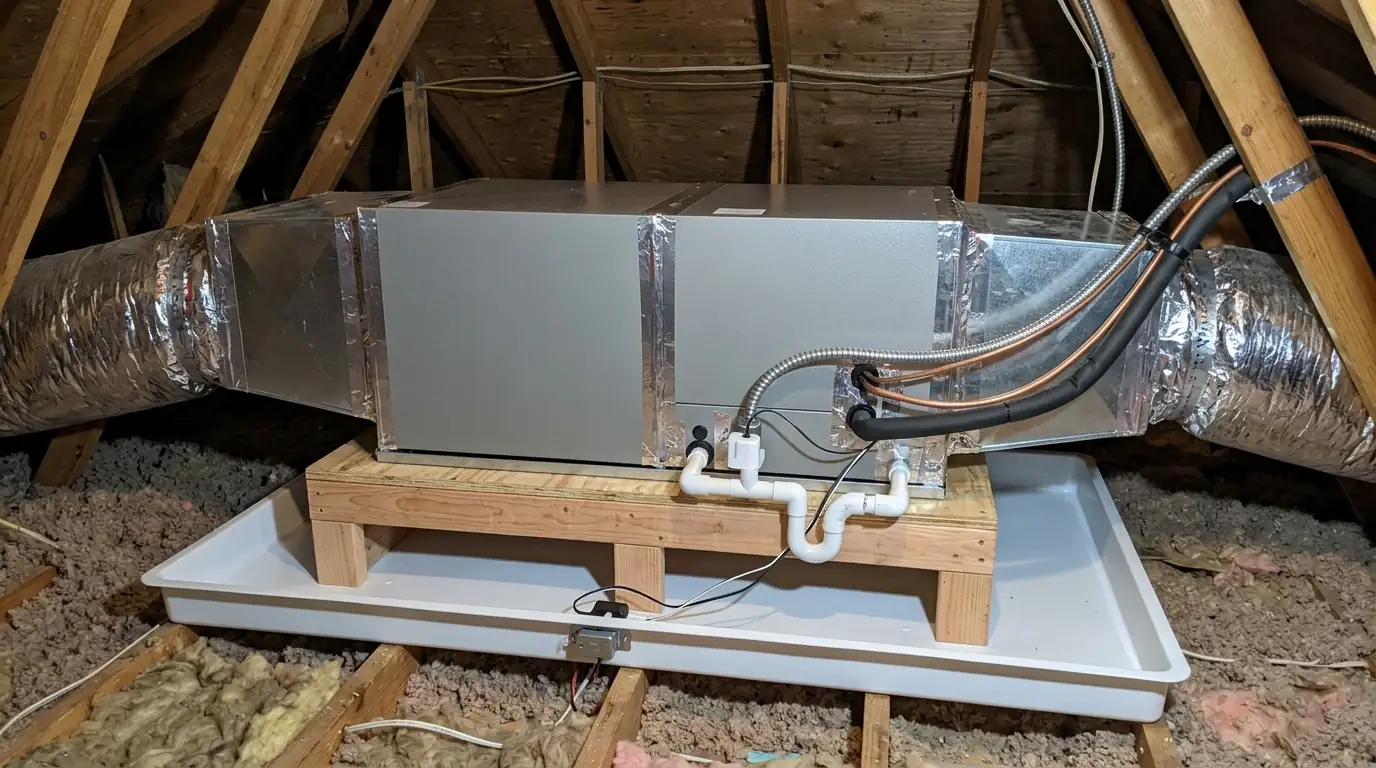
Attic air handlers are the norm in many New Orleans houses, and attics make every step harder: the old unit has to come out through a hatch or pull-down stair, and the new one has to go in the same way. We plan the route first, protect the ceiling below, set the new unit on a level platform in a new secondary pan with a float switch, and make sure there is a clear service path to it. Attic heat is brutal, so we seal and insulate the plenum connections carefully.
Closet and hall air handlers
Closet units sit inside the living space, which makes them easier to reach but puts noise, return air and drainage right next to bedrooms. Many older closets were built around a unit that is now larger or smaller than its modern equivalent. We check the closet's dimensions, the return opening, the filter location and the drain path before choosing a unit, and we seal the closet so the system pulls return air from the house rather than from the walls or attic. Quieter variable-speed models suit closets especially well.
Variable-speed air handlers
A variable-speed air handler uses an ECM blower that ramps up and down instead of switching between fixed speeds. Paired with a two-stage or variable-speed outdoor unit, it runs longer at low speed, which pulls more moisture out of the air, evens out temperatures and cuts noise. It also copes with restrictive ductwork better than a fixed-speed blower. It costs more up front, so we explain plainly where it pays off, mostly in humid houses and two-story homes that run hot upstairs.
Attic air handlers in slab homes
Much of New Orleans East went up as 20th-century slab homes, and in houses like those the air handler and every duct sit in the attic, where summer heat is hardest on cabinets, coils and blower motors. When one of those air handlers is replaced, it has to be matched to an outdoor unit, and any new central AC installed in Louisiana must meet at least 14.3 SEER2, so the pairing is chosen with that floor in mind.
How an air handler replacement runs
- Check the matchOutdoor unit, refrigerant and capacity confirmed.
- Plan the routeHow the old unit comes out and the new one goes in.
- Remove the old unitRefrigerant recovered, old unit and pan hauled away.
- Install the new onePlatform, pan, float switch, plenums, lines and wiring.
- Charge and testVacuum, charge by weight, airflow and drain checked.
How long the system is down
A straight air handler swap is usually finished in a day. Attic units with tight access, new plenums or added heat strips can take longer, and we tell you before the work starts so you can plan around the downtime.