Short answer
If you see ice on the copper line outside or on the indoor coil, set the thermostat to off and run the fan only to thaw it, which can take several hours. Do not chip at the ice. Once it melts, the cause is usually a clogged filter, a weak blower or a refrigerant leak, and a technician checks airflow first, then refrigerant pressures, before adding anything.
Signs your AC is freezing up
Why an AC freezes in a hot city
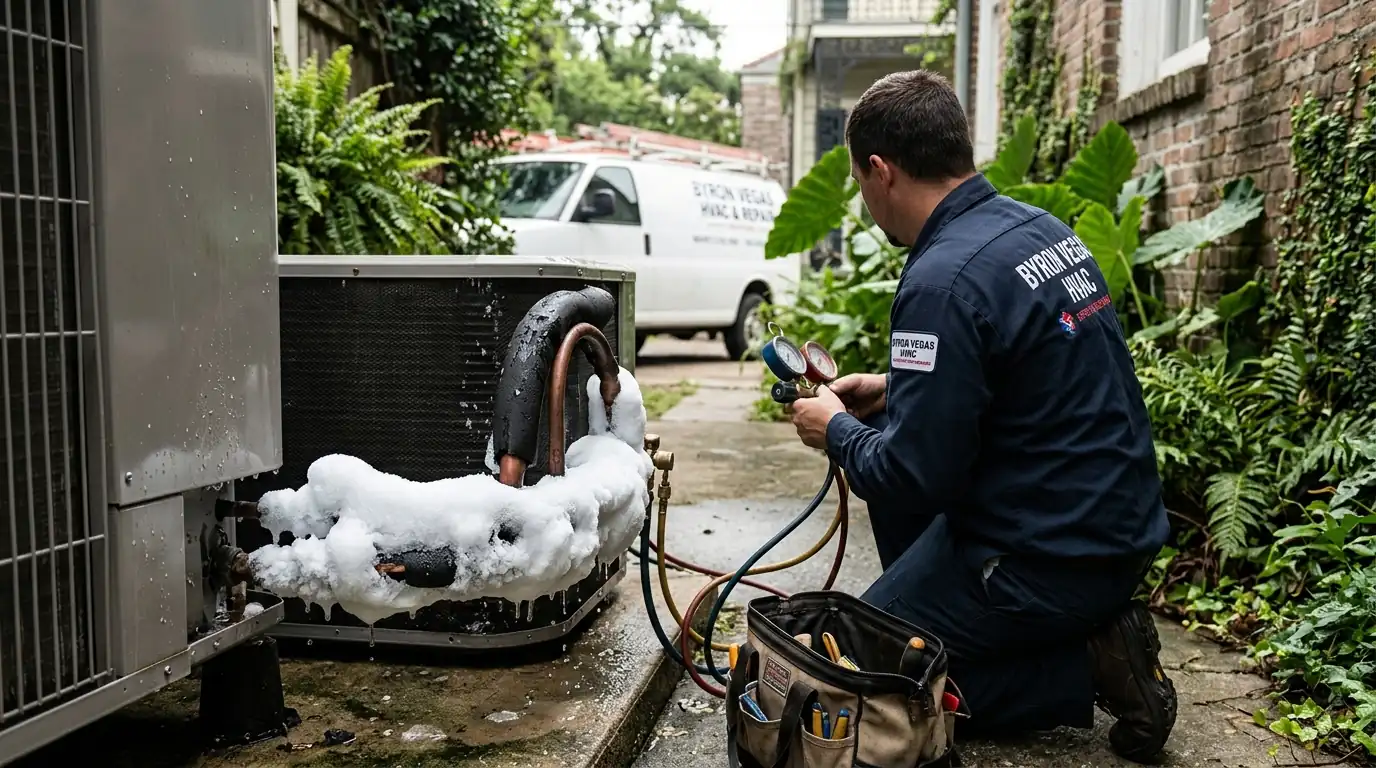
It seems backwards for an air conditioner to freeze in New Orleans in July, but the coil runs below freezing when it is starved. Too little warm air across it, from a clogged filter, a failing blower or closed vents, and the water it pulls from the air freezes instead of draining. Low refrigerant does the same by dropping coil pressure.
Ice blocks airflow further, so a small freeze grows until cooling stops. When it all thaws, the water can overflow the pan and reach a ceiling, which is why we check the drain line and float switch on every frozen-coil call.
Ice on the copper line outside
Frost or ice on the larger, insulated copper line at the outdoor unit means the indoor coil is running too cold and the ice has crept back along the suction line. It most often points to low refrigerant from a leak, though severe airflow problems cause it too. Adding refrigerant without finding the leak only delays the next freeze. We check airflow, measure pressures and superheat, and if the charge is low we find and fix the leak before charging the system by weight.
Ice on the indoor coil
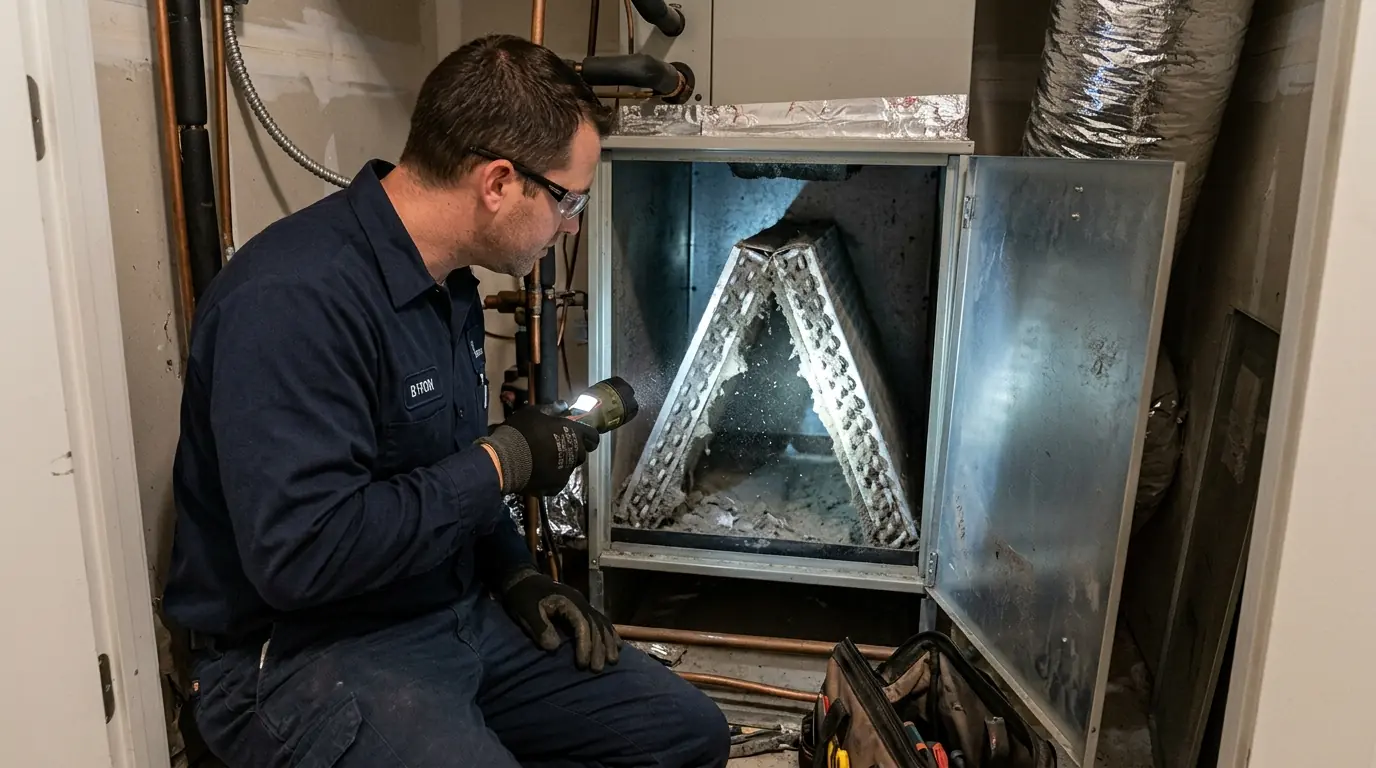
Ice on the evaporator coil itself, seen through an access panel or as frost on the air handler's cabinet, is most often an airflow fault. The coil may be clogged with dust and biofilm, the filter may be overdue, or the blower may be slowing down. After a full thaw we inspect or clean the coil, check the blower's speed and amp draw, measure static pressure, and look for closed or blocked returns. Airflow comes first, because a true refrigerant reading is impossible on a starved coil.
Freeze-ups from low airflow
Low airflow comes from more places than a dirty filter. Supply registers closed in unused rooms, a return grille blocked by furniture, undersized return ducts, crushed flex in the attic, or a blower set to the wrong speed after an earlier repair all starve the coil. Many of these causes are invisible without measuring. We check static pressure across the system, which shows whether the restriction is the filter, the coil or the ducts, and then fix the one that is actually choking it.
Why a coil freezes fast in New Orleans air
With summer humidity averaging about 76 percent in New Orleans, an indoor coil wrings a lot of water out of the air every hour it runs. When airflow drops, that moisture freezes on the coil instead of draining away, so a freeze builds faster here than it would in a dry climate. It is also why the thaw is so wet, and why we tell callers to set out towels and check the pan before switching the fan on.
How we fix a frozen AC
- Thaw it firstSystem off, fan on, towels down, pan watched.
- Check airflowFilter, returns, blower speed and static pressure.
- Measure the chargePressures and superheat read on a clear coil.
- Fix the causeAirflow corrected, coil cleaned or leak repaired.
- Run and watchWe run it long enough to prove it stays ice-free.
What a frozen-coil repair usually costs
- Filter or airflow fix. A filter, a blocked return or a closed register is the simplest cause.
- Coil cleaning. A caked coil needs cleaning in place.
- Blower repair. A weak blower motor or capacitor adds parts.
- Refrigerant leak. Finding and fixing a leak costs more than the freeze itself.
- Drain and pan. A thaw that overflowed may need the drain cleared.
Planning range: common central AC repairs, frozen coils included, typically run about $150 to $650; a leak repair costs more (source: thisoldhouse.com). It is a market range, not our price; we quote after we see the system.
What you can do right now
Safe to do yourself
- Set the thermostat to off, then fan on, to thaw the coil
- Replace a dirty filter and open closed supply grilles
- Put towels down and keep an eye on the pan
Leave to a technician
- Chipping or scraping ice, which can puncture the coil
- Adding refrigerant; the leak has to be found first
- Opening the air handler to clean the coil or test the blower