Short answer
Raising a condenser means recovering or pumping down the refrigerant, setting a stand tall enough to clear the water that collects in your yard, extending the line set and wiring, then reconnecting, vacuuming and testing. Straps or tie-down brackets anchor the unit to the stand. Many homeowners do it before storm season, or while replacing the unit, when the lines are open anyway.
Why height and anchoring matter
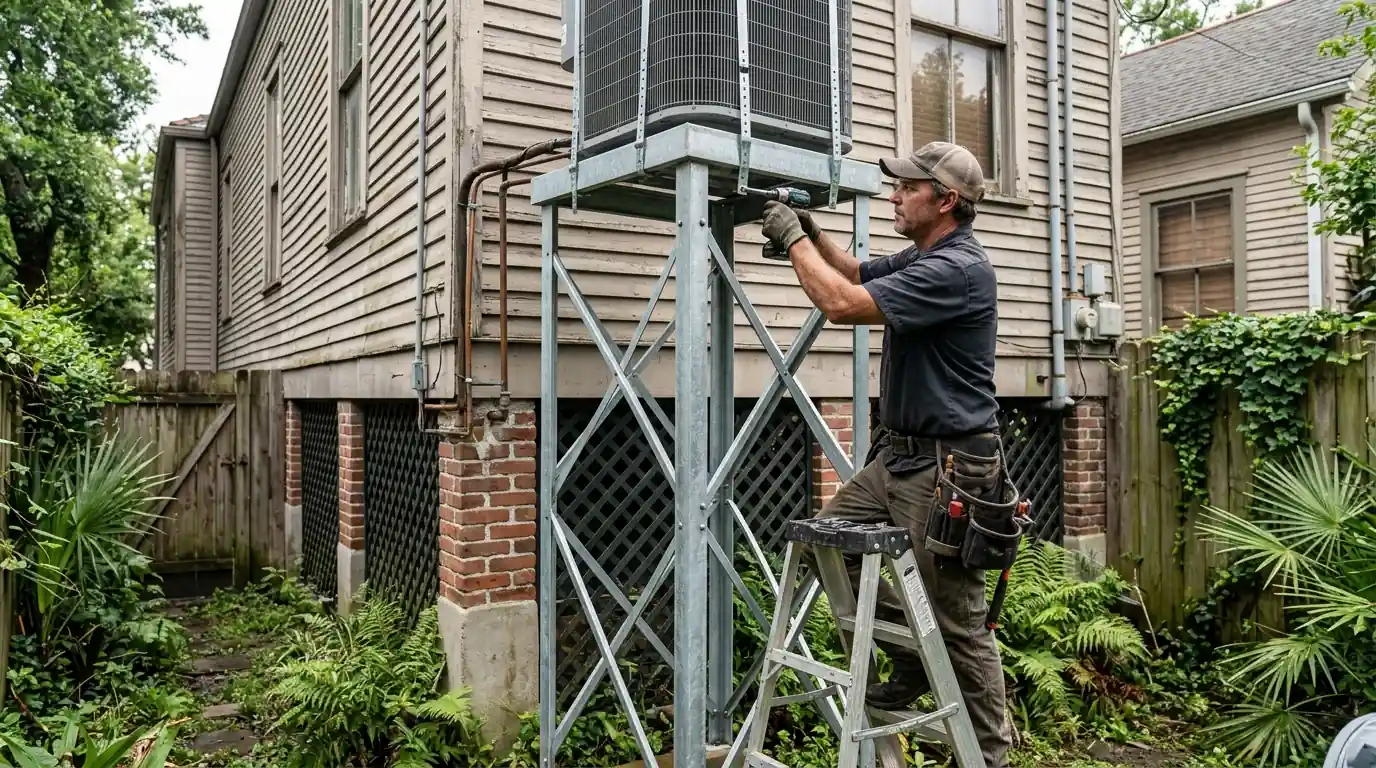
An outdoor unit holds the compressor, the fan motor, the coil and an electrical box with the contactor and capacitor. Water that reaches the electrical box or the compressor terminals ends the season, and silt left in the coil keeps doing damage after the water drains. A few feet of height keeps all of that above the water that pools in many yards after heavy rain.
Wind does a different kind of harm. A unit that is only resting on its pad can rock, shift and pull on the copper lines until one cracks and the refrigerant leaks out. Tie-down straps or brackets fixed to the stand or pad keep it in place. If the unit is due for replacement, raising it at the same time saves reconnecting twice; see AC replacement.
Choosing a stand
| Galvanized steel | Aluminum or composite | Raised platform | |
|---|---|---|---|
| Corrosion | Coated; watch cut edges | Will not rust | Depends on build |
| Height options | Common stock heights | Common stock heights | Built to any height |
| Best for | Most single units | Damp, shaded yards | Large or paired units |
| Anchoring | Bolted to pad or footings | Bolted to pad or footings | Built into the structure |
What a stand or tie-down job costs
We could not find a sourced local price range for this work, so here are the factors that move it.
- Stand height and type. Taller stands and platforms for large units cost more.
- Line set extension. Longer copper runs mean more material and brazing.
- Electrical extension. The disconnect and whip may need to move with the unit.
- Refrigerant handling. Pump-down, vacuum and recharge are part of every raise.
- Timing. Raising during a replacement avoids paying to reconnect twice.
What a raise-and-strap job includes
- Height agreed from your yard's water history
- Refrigerant pump-down or recovery
- Leveled, anchored stand or platform
- Line set extension, brazed and insulated
- Electrical disconnect and whip extended
- Vacuum, recharge and run test
- Tie-down straps or brackets fitted
Raising an outdoor unit above flood level
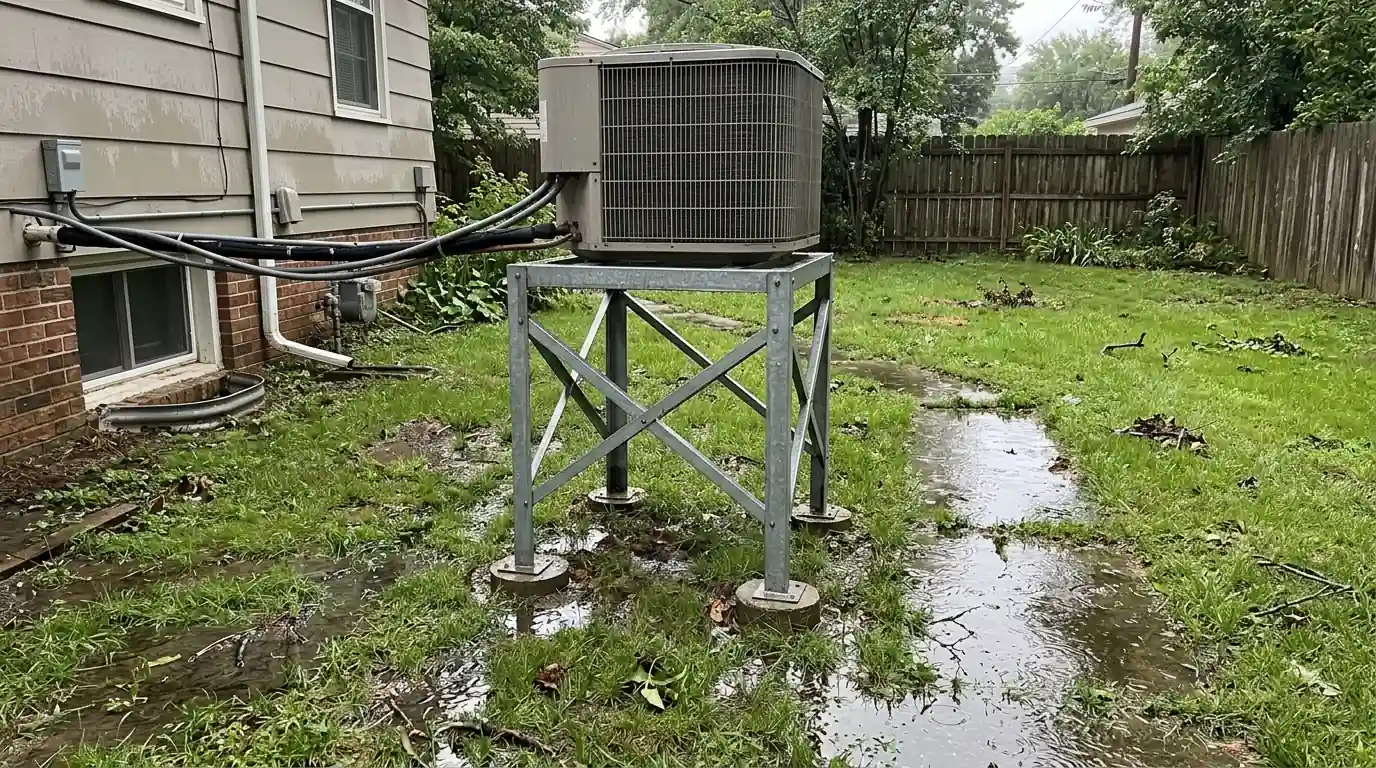
We start by asking where water actually stands in your yard after a heavy rain, and how high it reached in past storms, because that sets the stand height. The unit is pumped down or the refrigerant recovered, disconnected and lifted onto a galvanized steel, aluminum or composite stand, or onto a raised platform for larger units. The line set and electrical whip are extended to reach, insulated and secured. We then pull a vacuum, recharge, and test the system with the unit at its new height.
Hurricane straps and tie-downs
Straps go over the top of the cabinet or bolt to its base rails, then anchor to the stand or the concrete pad with corrosion-resistant hardware. On a raised stand the stand itself must also be anchored, otherwise the whole assembly can tip as one piece. We size the hardware to the unit, keep straps off the coil and the fan grille so airflow is not blocked, and check that service panels still open for future repairs. Straps are a small job and can be added to any unit.
What the last big storm taught New Orleans yards
Ida came ashore on August 29, 2021 with 150 mph winds, and the whole of New Orleans lost power for days. Upriver, floodwater surrounded homes near Norco in St. Charles Parish. Outdoor units that sat in water, or rocked loose and cracked a line, were among the failures when power came back. A raised, strapped condenser does not stop a storm, but it keeps the electrical box out of the water and the copper lines whole.
How we raise and anchor a unit
- Set the heightWe check where water collects and agree on a stand height with you.
- Pump down and disconnectRefrigerant is pumped into the unit or recovered, then lines and power are disconnected.
- Set and anchor the standThe stand is leveled and anchored, then the unit is set on it.
- Extend and reconnectLines and wiring are extended, brazed, insulated and secured.
- Vacuum, charge and strapWe vacuum, charge, test the system and fit the tie-downs.