Quick answer
Ducts under a raised house sweat when cold supply air meets damp crawlspace air through thin, torn or missing insulation. The water soaks the insulation, the runs sag and joints pull apart, so cooled air leaks under the house. The lasting fix is sealing every joint with mastic, wrapping the runs in a continuous vapor jacket and supporting them properly, or replacing runs past saving.
Why so many houses here have ducts under the floor
Shotgun houses were the most popular house type in New Orleans from the 1880s to the 1920s, often built entirely of cypress, and most of them are raised. Early shotguns sat on piers about three feet high. In the Bywater historic district about 90 percent of buildings are single story and virtually all are raised, and in Gretna's historic district most bungalows sit a few feet above grade.
None of these houses were built for ductwork. When central air arrived, the easiest place to run ducts was under the floor, where there was room to work. That decision still shapes the HVAC problems in thousands of homes.
Why under-floor ducts sweat
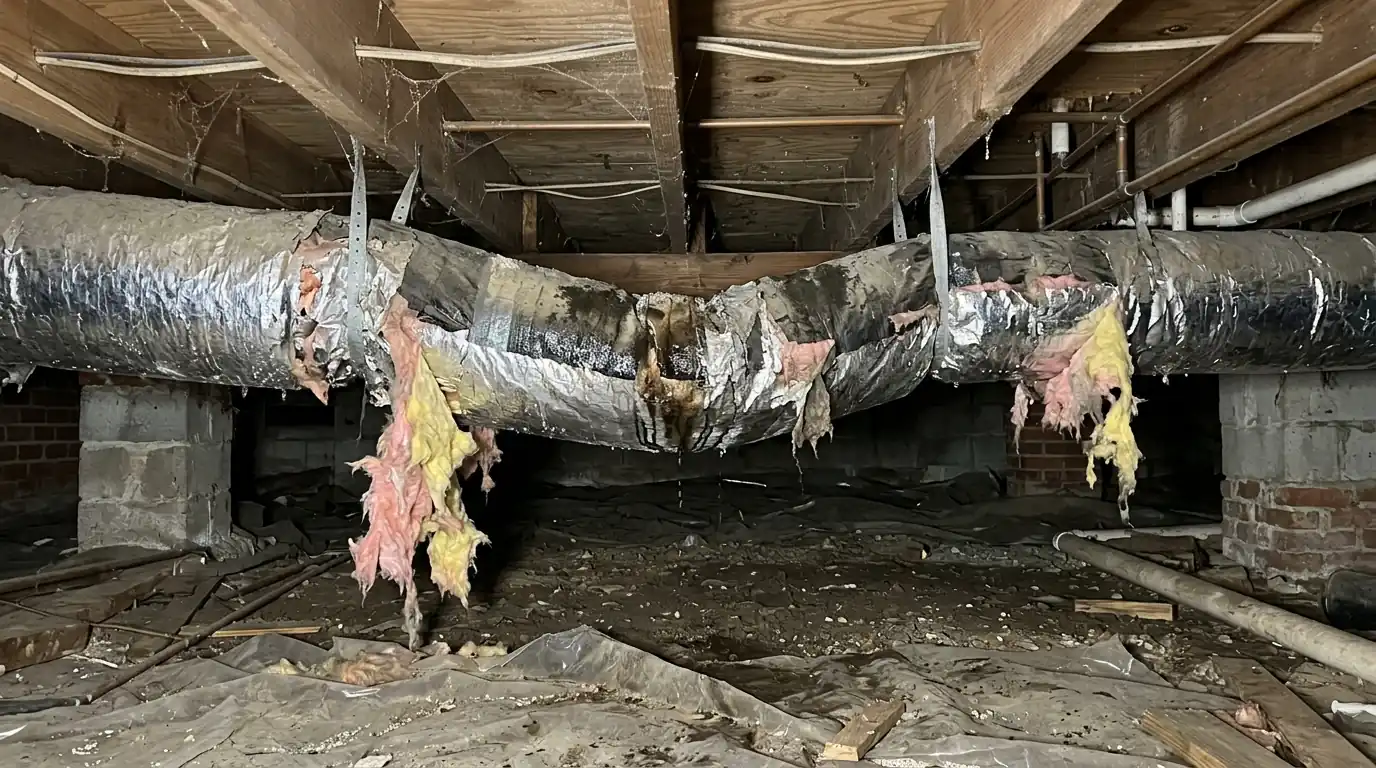
A supply duct carries air in the 50s. The crawlspace air around it is warm and humid for much of the year, and any part of the duct whose outer surface drops below that air's dew point collects water, the way a cold glass does on a porch. Where insulation is thick and sealed, the outer surface stays warm and dry. Where it is thin, compressed, torn or missing, the duct sweats.
The water soaks into the insulation that is left, making it heavier and less effective, and drips onto the soil below. Over a season the runs sag, joints pull apart, and some of the cooled air ends up under the house.
Signs your under-floor ducts need work
The fixes that last
- Trace every runFind disconnected joints, crushed runs and wet insulation.
- Seal the jointsMastic and mesh at every connection, not cloth tape.
- Rewrap the runsContinuous vapor-jacketed insulation with taped seams.
- Support them properlyWide straps at close spacing so runs stay straight and level.
- Seal the bootsFloor boots sealed to the floor so humid air cannot reach the cold metal.
Most systems come back with these steps. Our duct sealing and insulation page covers the work in detail.
When replacement is the better answer
Runs that sat in floodwater should be replaced, not cleaned, because flex duct and duct board hold silt and moisture. Ducts crushed in many places, sized wrong for a new system, or so waterlogged that the inner liner has failed are also better replaced. This Old House puts the average duct replacement at about $1,450 to $8,000, with a full range of $250 to $12,000, and HomeAdvisor puts typical ductwork installation at about $453 to $2,189.
Sometimes the better answer is to stop fighting the crawlspace. Ductless mini-splits, or a small-duct system fed from the attic, avoid under-floor ducts entirely, which suits some houses well.
Keeping them dry
- Keep crawlspace vents and drainage working so water does not pool
- Check the runs after big storms and floods
- Replace insulation that animals have torn
- Keep the AC drain line discharging away from the crawlspace
- Have the ducts looked at during a spring tune-up
Sources
Figures in this guide come from these sources. Programs and prices change, so check current terms.
- Fox 8: the history of New Orleans shotgun houses
- National Park Service: Bywater historic district nomination
- National Park Service: Gretna historic district nomination
- Journal of Light Construction: New Orleans houses on piers and slabs
- This Old House: air duct replacement costs
- HomeAdvisor: ductwork installation costs
About this guide. Ward Teague writes the HVAC guides for Byron Vegas. Each guide starts from questions people ask when they call, and the figures in it come from the sources listed at the end of the article. More about the writer.