Quick answer
For older New Orleans homes, ductless mini-splits suit houses where only some rooms need cooling or walls must stay untouched; small-duct high-velocity systems give whole-house central air through small tubes with little demolition; and conventional central air fits houses with room for ducts in the attic or under the floor. The choice comes down to the rooms, the plaster and the budget.
What makes older homes hard to cool
Shotgun houses were the city's most popular house type from the 1880s to the 1920s, often built entirely of cypress and usually raised. Their rooms run front to back without hallways, many have little usable attic, and walls are often plaster. Camelbacks add a second story at the back under its own roof. None of that leaves an obvious place for conventional ducts.
That is why so many older homes still run window units, or have central air with ducts hung under the floor where they sweat. Each of the three options below solves the problem a different way.
Ductless mini-splits
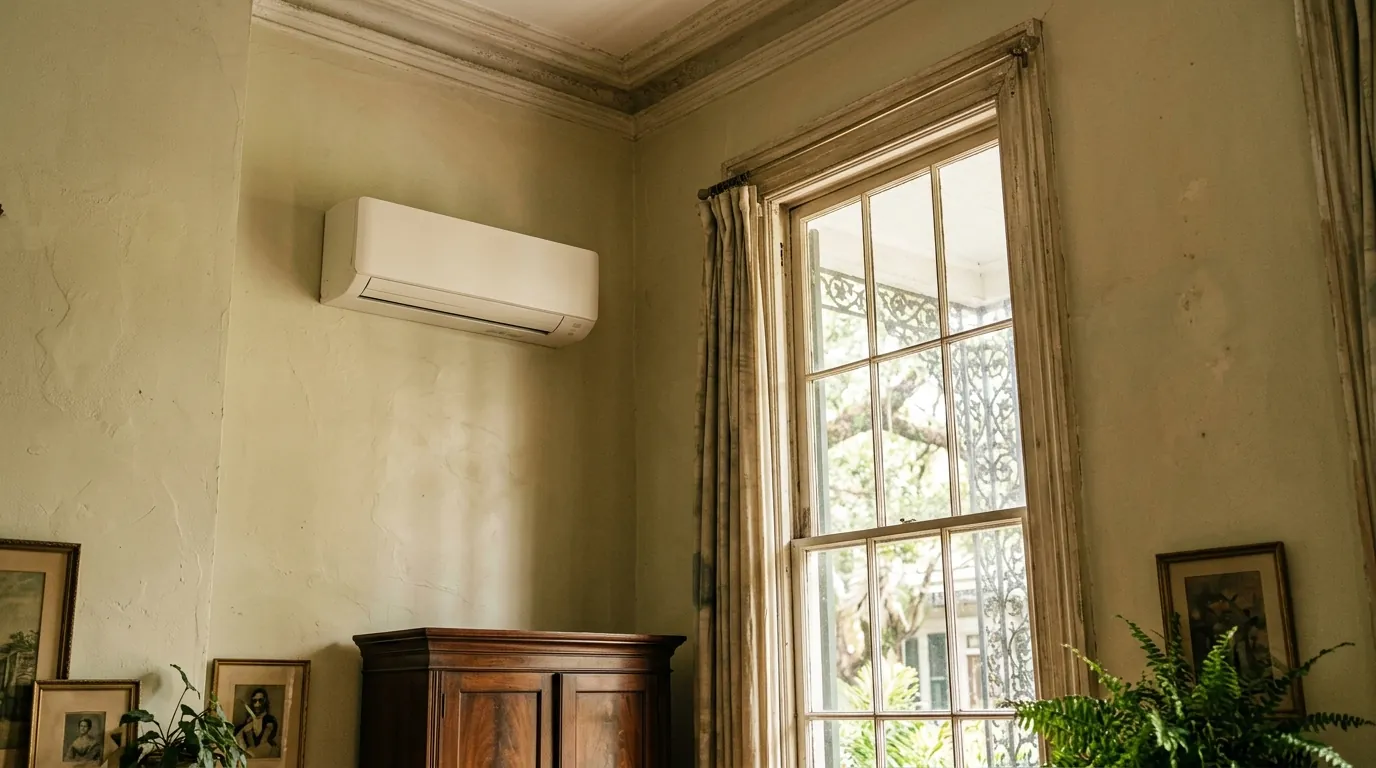
A ductless system pairs an outdoor unit with one or more indoor heads mounted high on walls or ceilings. Each head is its own zone, the line sets run through a small hole per head, and nothing needs to go under the floor. Bryant puts the cost at about $2,000 to $7,000 per zone.
Mini-splits suit houses where only some rooms need help, doubles where each side wants its own system, and owners who want to avoid ducts entirely. Their trade-off is a visible head on the wall. See mini-split installation.
Small-duct high-velocity systems
A small-duct system uses a compact air handler feeding flexible tubes about two inches across, which snake through wall and floor cavities and end in small round outlets. It gives whole-house central air with very little cutting into plaster, removes humidity well, and hides almost everything.
It usually costs more than a conventional system and needs careful layout to stay quiet. See small-duct high-velocity systems.
Conventional central air
Where the house has a usable attic, or a crawlspace with room for ducts, conventional central air is usually the least expensive whole-house option, with standard grilles in each room. Raised houses can run ducts under the floor, but those runs need sealed joints and a continuous vapor jacket to stay dry. See central air installation.
Side by side
| Ductless mini-split | Small-duct | Central air | |
|---|---|---|---|
| What shows indoors | Wall or ceiling heads | Small round outlets | Standard grilles |
| Demolition | Minimal | Minimal | Can be heavy in old homes |
| Whole-house cooling | One head per room or zone | Yes | Yes |
| Humidity control | Good with inverter units | Strong | Depends on sizing |
| Typical cost | $2,000 to $7,000 per zone | Highest of the three | Lowest where ducts fit |
How to decide
- Count the rooms that need coolingA few rooms favor ductless; the whole house favors ducted options.
- Look for spaceA usable attic or crawlspace makes conventional ducts possible.
- Decide what to protectPlaster, trim and ceilings favor small-duct or ductless.
- Think about humiditySmall-duct and variable-speed systems handle moisture best.
- Check rebatesEnergy Smart has offered up to $500 when a mini-split heat pump replaces strip heat.
Many older homes end up mixing systems: central air downstairs, and a ductless head in the camelback or a back addition.
Sources
Figures in this guide come from these sources. Programs and prices change, so check current terms.
About this guide. Ward Teague writes the HVAC guides for Byron Vegas. Each guide starts from questions people ask when they call, and the figures in it come from the sources listed at the end of the article. More about the writer.